
Ravindra Shukla picks out his best option.

'We saw how vigorous democracy was when it dislodged authoritarianism under Indira Gandhi. We saw its vigour again when it voted Mr Modi out of humble origins as prime minister. It was Nehru who laid that foundation for India and what is worrying today is Modi's rather imperial style of functioning,' says writer Nayantara Sahgal.

There are signs of China's external behaviour becoming more aggressive in the coming years. If that happens, strategic implications for neighbours having territorial disputes with China can become deeper and imperatives can rise for the former to counteract, says D S Rajan
This quiet assertion of China has allowed various smaller countries of South Asia to play China off against India. Most states in the region now use the China card to balance against the predominance of India. Forced to exist between their two giant neighbours, the smaller states have responded with a careful balancing act, says Harsh V Pant.

The joint statement issued after Prime Minister Narendra Modi and President Barack Obama's first-ever summit is high on intent and ambition. Notably missing from the statement is India's refusal to be America's partner in its war against ISIS.

The prime minister, says Ram Kelkar, could do a lot to advance his stature as a national leader by speaking in strong and unequivocal terms on the subject of opposing intolerance and emphasizing the rule of law, thereby setting the tone for the nation and the party.

An inspired performance from Douglas Costa helped Brazil to a 3-0 win over Peru on Tuesday and lifted them into third place in the South American qualifying group for the 2018 World Cup in Russia.

'It is imperative to restore the dignity and authority of the services chiefs. Erosion of this has resulted in lowering of service efficiency. It is also time to end the practice of taking seniority as the sole criterion for appointing chiefs.'

'The real test will be in defence-related deals, for instance the Javelin anti-tank missile: Is the US willing to co-develop something with India, on terms that will support the 'Make in India' initiative? Is there defence technology transfer? Or will it dump old junk on India?' asks Rajeev Srinivasan.

'... A youth movement which could really transform our politics in a way that the existing elites don't understand.' 'The more you suppress free expression, the more people will value it.' 'The State can't suppress a young society like India where there are so many interesting new ideas emerging,' says Sunil Khilnani, whose latest book Incarnations looks at Indian history through 50 lives.

'Pakistan is full of 'religious entrepreneurs' like Hafeez Saeed who poison the minds of the young so that they can be motivated to become terrorists. They work in concert with the rulers of Pakistan. It is a private-public partnership.'
'As the first leaders of their respective countries born after Indian Independence and the Chinese Liberation, Modi and Xi would be expected to have the ability to overcome the traditional mindsets and the hierarchical nature of their official/bureaucratic establishments,' say Alka Acharya and Jabin T Jacob.
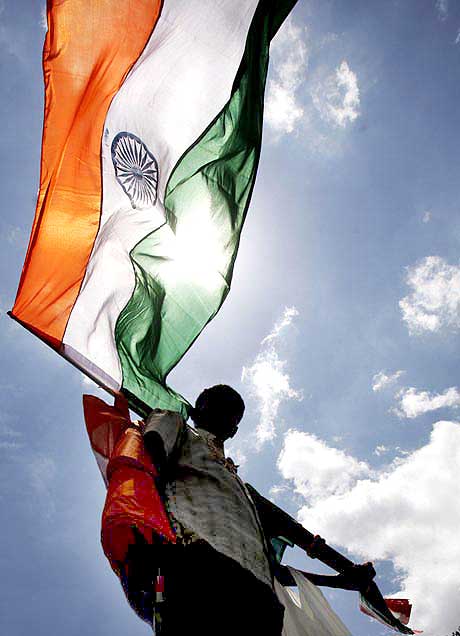
How has the Indian State, in principle and practice, given shape to the essential ingredients of the secular principle and composite culture?

Moving ahead with their new mantra -- Chalein Saath Saath: Forward Together We Go -- Prime Minister Narendra Modi and United States President Barack Obama on Tuesday vowed to deepen cooperation in every sector for the benefit of global stability and people's livelihoods over the next ten years.

'The year in pictures' treks across the globe, looking back on the moments that shaped 2016. From the United States presidential race, to demonetisation in India to the refugee crisis, the news has kept pouring in. Here are our top 50 moments from the world.
he has to demonstrate the ability of his government to take a quantum leap, almost tantamount to setting the Ganga on fire, in the next six months, if not in 100 days, if the people were to take seriously the cascade of commitments spewing out of the President's address to both Houses of Parliament on June 9, says B S Raghavan. B S Raghavan suggests five practical propositions through which the Modi government can bring in paradigm changes.

'The BJP had ruled earlier too, but nothing of this sort happened then... I don't say the government is behind the attacks, but they don't do anything to stop the attacks.' 'The prime minister has to tell the perpetrators that it is not in the interest of the government that such incidents happen.' 'When somebody says all Indians are Hindus, responsible people should ask him to stop and assure the country that this is not the opinion of the government. But it is not happening and it is quite unfortunate,' Cardinal Baselios Cleemis tells Shobha Warrier/Rediff.com in an exclusive interview.

This is the joint statement issued by the ministry of external affairs on the visit of US President Barack Obama to India.

The India that needs strategic alliances, defence cooperation and engaging meaningfully with neighbouring countries is quietly moving ahead with confidence, says Tarun Vijay

Dani Alves has blamed the media for Brazil's unsuccessful World Cup campaign but conceded that the team did not prepare properly ahead of the humiliating 7-1 defeat by Germany in the semi-final.
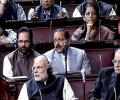
It is not in the Lok Sabha, where the BJP has a clear majority, but the Rajya Sabha that the Opposition has ganged up to checkmate Prime Minister Narendra Modi's ambitious plans.

President Pranab Mukherjee on Monday addressed the first joint sitting of Parliament as mandatorily required under the Constitution after the general elections. The address is the political, economic and foreign policy road map of the Narendra Modi government and covers virtually all crucial areas.
 © 2026 Rediff.com - Advertise with us - Disclaimer - Privacy Policy - Sitemap - Feedback - About us - Terms of use - Grievances